A twelve-year-old artist, the therapist who carried her through grief, and the attention problem giftedness had helped her outrun.
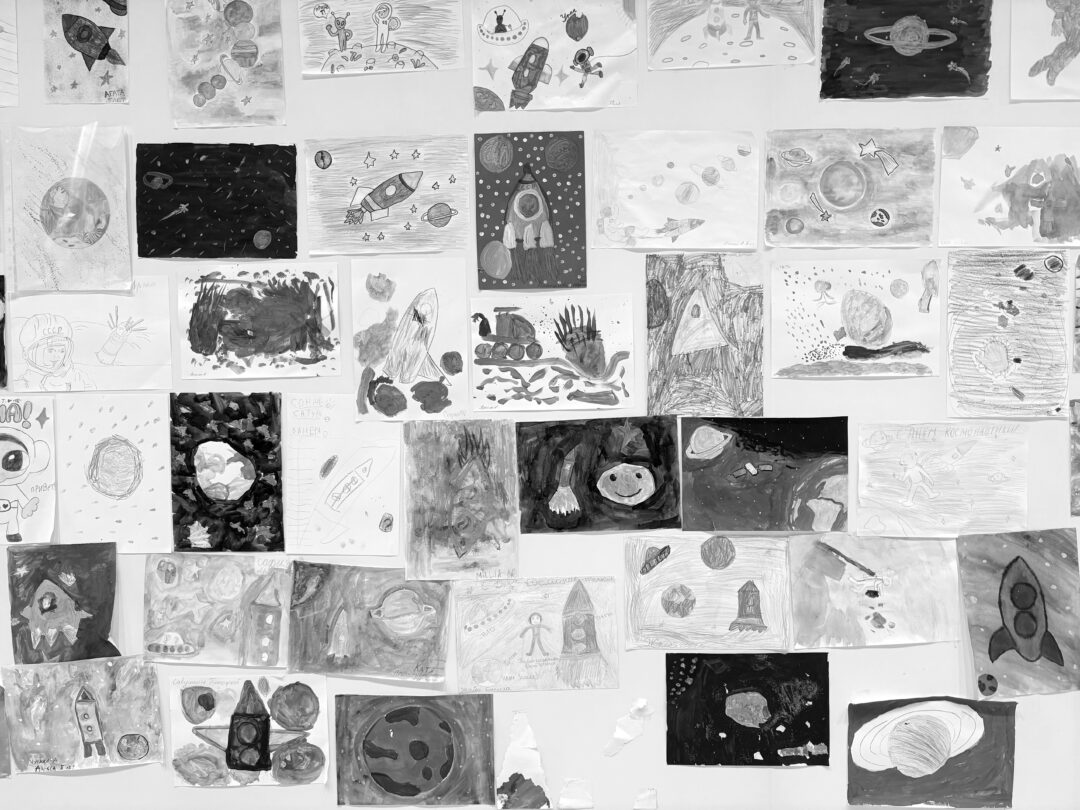
Savannah’s therapist keeps her drawings. Five years of them, taped to the office wall in slow rows, from the crayon houses of a seven-year-old to the cross-hatched portraits she makes now. The tape has yellowed at different rates. You can read the whole treatment in the corners.
The office smells like chamomile and the good kind of clutter. Plants on the sill. A kettle that runs most of the day. The overhead lights stay off because Savannah has never liked them, and the lamps are low and warm. Five years of Tuesdays, and the room learned her.
The therapist entered Savannah’s life the week of her father’s funeral. Savannah was seven. What followed was the kind of work a progress note can document but not contain: a steady adult who was not family walked Savannah through the worst year of her life, and she came out the other side attached, regulated, and still herself. Before this was a diagnostic question, it was a record of care. The five years were not the backdrop of this case. They were the foundation of it. They also made the therapist the person most likely to notice when the old explanation stopped fitting.
Savannah is twelve now. Seventh grade. An artist, seriously, the kind whose teachers keep her work. There is a new stepfather at home, careful and kind, the sort of man who knows he is new to the table. And there were concerns, the quiet kind. Light social anxiety. Overstimulation in loud rooms. Sensitivity to scratchy fabric and fluorescent light. A tendency to drift in class, and lately, to nod off over homework.
It was the stepfather who named the nodding off, precisely because he had no history to explain it with. Everyone else had five years of narrative available. He had a girl at the kitchen table whose eyes closed mid-sentence over a worksheet, and he asked about it at dinner with a newcomer’s caution. “Does she always fall asleep sitting up?”
The referral came from the therapist, and it came with a hypothesis she had done her reading on: masking. High-masking autism in bright girls is a real clinical concern, and it has been missed often enough that careful clinicians take the question seriously. The profile she was watching had a literature behind it: sensory sensitivities, social effort, an intense inner world. She asked the question the right way. Rule it in or rule it out, properly.
The workup
Cognition first. Stanford-Binet, Fifth Edition: a full scale of 146. In this case, nearly every finding had to be read against the force of that score. The number is not a decoration. It is the central confound of the evaluation, because a mind like that can compensate so well that impairment arrives late to the adults watching it.
Sleep was screened before anyone said the word attention, because a twelve-year-old nodding off has earned that. Bedtime, screens, snoring, restless legs: unremarkable. Then the history, and here the case quietly reorganized itself. Her early report cards used soft language. Dreamy. Her mind wanders, understandable given everything. The phrase given everything followed her through elementary school like a caption. Every symptom had a better explanation available, and the record used it. Almost nobody catches ADHD in a grieving seven-year-old. The grief did not cause the inattention. It absorbed it.
The rating scales converged. On the BRIEF-2, her mother and Savannah herself flagged the same systems: working memory, task initiation, sustained attention. Her self-report mattered, because a twelve-year-old with a 146 knows exactly which part of her mind will not hold. The BASC-3 told the same story from a wider angle, attention problems elevated, the social scales settling once anxiety was accounted for. Classroom observation matched. Present, pleasant, gone by minute fifteen, and back the moment the work touched something she cared about.
The spectrum question got a full answer, not a wave. SRS-2 unremarkable outside the anxiety overlap. The ADOS-2 pointed the same direction: reciprocity fluent once she warmed, repair skills intact, imagination everywhere. Her social trouble was anxiety-shaped, not autism-shaped. It eased with familiarity instead of persisting through it. Her sensory sensitivities were real, and they are transdiagnostic, common in anxious kids, in gifted kids, in artists. Her idiosyncrasies were style without rigidity. She has intense interests, not insistent ones. She shifts sets fine. She is, in the oldest clinical language available, a character: vivid, particular, not rigid. The threshold was not crossed.
The CPT-3 came back borderline, and borderline is a label, not a finding, so I looked at the shape underneath it. Fast responses. Little hesitation. Wrong in a particular way: commissions up, response time variable, the signature of a quick mind pulling the trigger before the target settles. Inhibition and sustained attention, lightly but consistently loose.
Then the argument that has to be made carefully, because this kind of reasoning can be misused. Her attention scores sat in the average range for her age. Against a 146, that is not reassurance. It is a canyon. Ipsative comparison, scores read against her own cognitive line rather than the population’s, is a clue and never a diagnosis, and I want to be exact about which weight it carried. The diagnosis stood on impairment: the nodding off, the unfinished work, the informant convergence, the functional cost that had finally outrun her compensations. The ipsative gap did not prove anything. It explained something. It explained how a real attention deficit stayed invisible for five years inside a mind that could do the executive system’s work by hand.
The right verb, the wrong noun
Which brings the case back to the therapist’s hypothesis, and here is the sentence this evaluation owed her: she was right that something was masked. Right verb, wrong noun. The mask was not covering an autism-spectrum pattern. It was a 146 covering an attention deficit. Intelligence had been doing manually, for years, what her executive system would not automate, and middle school was the first workload that outran even that.
This finding does not diminish the five years. It explains their timing. The symptoms sat below every adult’s noise floor because a better explanation was always available and because the child was, by force of raw cognition, compensating in real time. The therapist did not miss it. It was not catchable yet. The impairment crossed threshold when the demands did, which is often when these diagnoses surface in gifted children, and not a semester before.
Behavioral first
Feedback included a psychiatric consult, and the psychiatrist, reading the same file, recommended what the file supported: a low-dose stimulant trial, carefully run. The therapist asked, gently and professionally, whether the family might try behavioral supports first. Executive coaching. Structure. Skills.
I want to hold that request up to the light, because it deserves better than the plot is about to give it. Behavioral first is a legitimate sequence. Reasonable clinicians choose it every week, and the asking was not an error. But underneath the professionalism, there was also the human fact of attachment. She had entered this child’s life the week of a funeral. For five years she had been the steady adult who was not family, the keeper of the era that ended when Savannah’s father died. Now, in a single season, there was a new father at the dinner table and a capsule proposed for breakfast. From her chair, both looked like they had arrived to do work that used to be hers. Professional love is real love with a discharge date built in, and nobody writes protocols for the day you can feel it approaching.
The family honored her request, fully. An executive coach, twice a week. A structured after-school program. Checklists, planners, timers. It failed, and it failed for a specific reason worth naming, because the failure indicts the match and not the modality. This version of skills coaching treated the problem as a knowledge deficit. Savannah’s problem was performance, not knowledge. She could articulate the strategies beautifully, and then not run them at four in the afternoon, because articulation was never the broken part. The program stacked more manual labor onto the one system already exhausted from a school day of compensation. Her grades slipped further. The drawings stopped entirely. She came home from the coaching hollow.
Two weeks
The psychiatrist started a low-dose stimulant in the spring, with the boring, correct machinery around it: morning dosing, appetite and sleep watched, a follow-up on the calendar before the first capsule was swallowed. The goal was not to make her exceptional. It was to make the ordinary day possible.
Her mother asked the question every artist’s parent asks. “Will it dull her?” It did not. The work did not flatten. The line quality did not change. What changed is that drawings started getting finished. Homework stopped being a hostage negotiation. The nodding off ended the first week. Her teachers used the word present. Savannah, asked how it felt, said the quietest, largest thing in the file. “It’s like the noise isn’t in charge.”
A good response did not prove the diagnosis after the fact. It became one more piece of convergence.
And here is what the two weeks owed the five years: the medication could help without the attachment. It could not have been used this well without it. Medication can support regulation. It does not build trust, or a self that believes adults show up. It inherited those. The capsule walked into a nervous system that five years of Tuesdays had helped keep organized through the worst thing that ever happened to her. The two weeks worked because of the five years. To read this as the pill defeating the therapy is to read the case upside down.
But something in the Tuesday hour changed shape, and it has not changed back. The sessions used to be where Savannah came to get regulated. Now she arrives already regulated, and the hour is quietly interviewing for its new job. Some of the silence between them is the old kind, comfortable, five years deep. Some of it is new. The therapist has said nothing wrong and done nothing wrong. Something has shifted anyway, and both of them can feel it, and neither has a name for it yet. Not every finding in a case resolves. Some just get carried.
In late spring, Savannah brought a drawing to session. Finished, signed at the corner, the first completed piece in a year. The therapist looked at it longer than the drawing required. Then she reached for the tape and put it on the wall with the other five years.
The case described here is a fictional composite drawn from clinical experience. Details have been altered and combined, and no individual client, family, or clinician is depicted.